

Upstream Issues
Friends of the Pecos River intentionally focuses activities on the stretch of the Pecos from Imperial to Sheffield (what we call The Forgotten Reach). But we cannot avoid the many complex historic, cultural, economic and natural issues upstream. There is not a single response to the questions of why the river is in decline and what can be done to halt that decline. Nor is there a silver bullet to reviving the river.
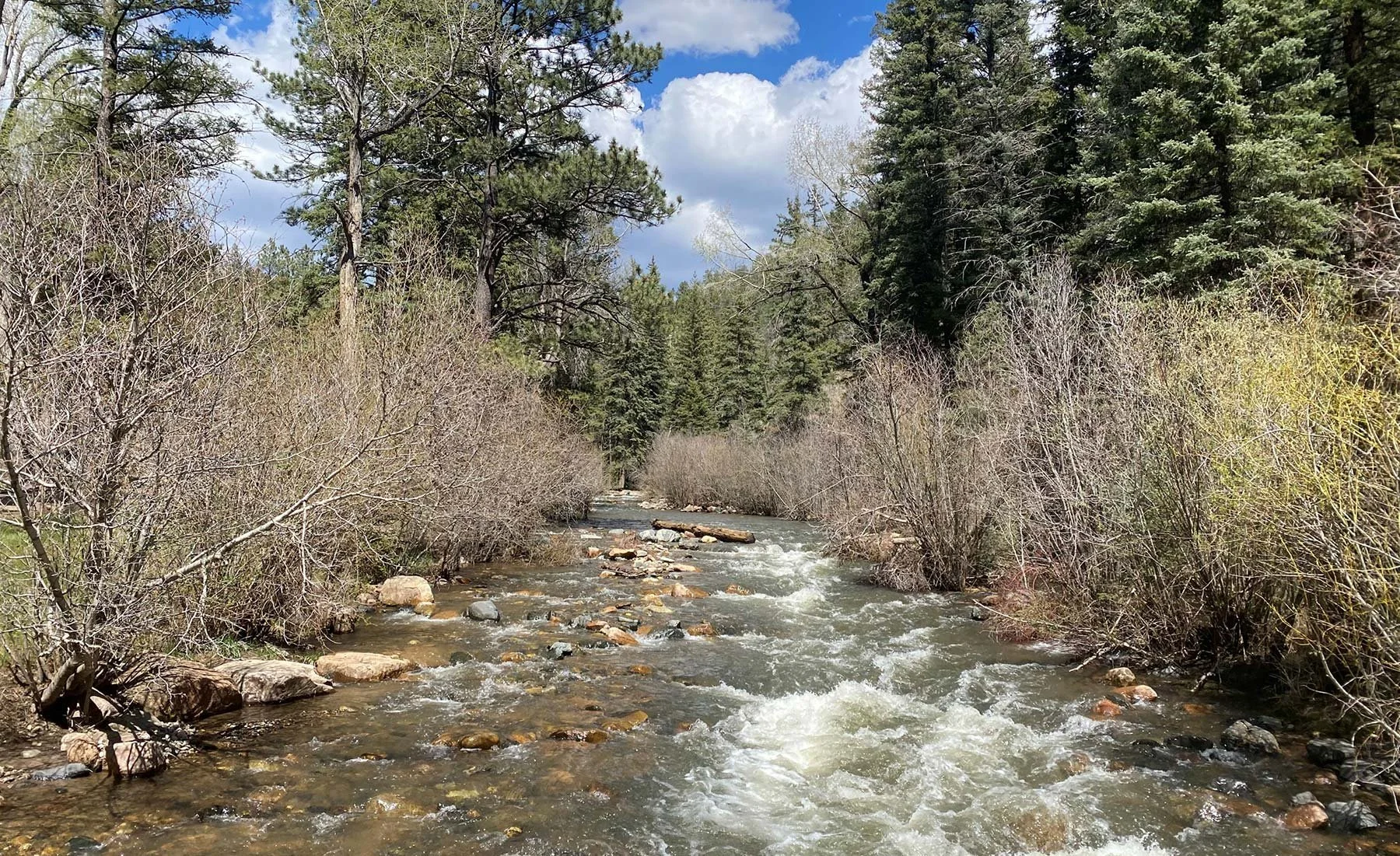
Pecos River issues begin in the Sangre de Cristo Mountains, where reduced snowmelt, mining, and increased forest fires have altered the headwaters. Downstream, the flow has also been impacted by numerous impoundments of various scales; flaws in the Pecos River Compact between Texas and New Mexico; outdated agriculture irrigation distribution systems; a lack of instream flow releases from reservoirs; a decline in healthy rangelands, grasslands and ecosystems; high levels of groundwater pumping that have lowered the groundwater table and disrupted the water cycle; naturally occurring drought; and natural concentrations of salts and minerals.
We envision a shared voice for the river and basin represented by land stewards who understand the water cycle and care about upstream issues that affect river flow and water quality.
Produced Water
The biggest conversation in the Permian Basin today is what to do with excess contaminated produced water. This presents both an opportunity and a threat for our river and region.
Produced water is the water that comes out of the ground along with oil and gas during production. The shale revolution of the early 2000s—the boom in oil production when horizontal drilling and hydraulic fracturing took off—increased the volume of groundwater used for oil production and significantly increased the volume of produced water.
The numbers vary depending on the source. AI says the Permian Basin generates up to 33 million barrels of produced water daily. For every barrel of oil pumped, approximately five to seven barrels of wastewater are also brought to the surface. This wastewater can be five times saltier than the ocean, and it is loaded with chemicals and contaminants.
Traditionally, produced water has been disposed of by reinjection below the surface through injection wells. However, disposal by this method has been proven to trigger seismic activities, earthquakes and high underground pressure resulting in dangerous well blowouts and sink holes thereby threatening regional groundwater systems. Regulators are limiting where injection can occur, and the oil industry is finding itself with a problem: What can safely and economically be done with all this wastewater?
With water demands increasing and water supplies decreasing in Texas, the beneficial reuse of treated produced water may present an opportunity for agriculture, industry and most importantly from our perspective, the water cycle and the Pecos River.
Friends of the Pecos River joined the Texas Produced Water Consortium (TxPWC) to learn, stay involved and bring the voice of the river to the conversation. TxPWC, housed at Texas Tech University, was created and funded by the Texas Legislature in 2021. The stated purpose of the consortium is to bring together information and resources to study the economics and technologies related to beneficial uses of produced water, including environmental and public health considerations.
Much of the conversation is related to water quality and the effectiveness (or ineffectiveness) of various treatment strategies: What level of treatment will be safe and what will satisfy the Texas permit process for various “beneficial uses?”
What we’ve been spending time on is contemplating how this water (assuming appropriate treatment levels are achieved) could truly benefit the long-term health of the Pecos River:
Enough produced water should be available so that 100% of all water used for the oil production process could come from recycled produced water. Industry could elect not to pump fresh groundwater for production moving forward. In time, this could improve groundwater surface water interaction and inflows to the Pecos River.
Proposals to discharge treated produced water into Red Bluff Reservoir should include commitments for instream flow releases from Red Bluff to allow for improved flow downstream, rather than selling new water from the reservoir. This would mean a new system of managing releases.
Proposals to discharge into tributaries need careful consideration to ensure that ecosystems are protected. Riparian restoration will be needed to realize the true benefits of the discharge because evaporation and saturation will consume most of the stream flow for a considerable amount of time.
Wetland projects could be considered; appropriately treated produced water could be used to enhance the river in areas of extreme drying and to create migratory bird habitat in areas where waterfowl has been on the decline.
Proposals to discharge on land for agricultural projects could work if regenerative strategies prioritizing ecosystem health (rangeland restoration) are used, versus conventional soil depleting methods (such as row crops).
We strongly encourage land application projects that promote rangeland and grassland restoration. If done correctly, this could provide true long-term improvements to the water cycle by slowing down water and enhancing the alluvial aquifer that historically seeped into the river.
Using treated produced water for industrial projects such as data centers is an option for regional economic growth. However, this strategy doesn’t benefit the river.
Because this is a limited resource that will deplete over time, it should be used to restore the river’s water cycle for long-term benefit, as opposed to short-term industrial or commercial enterprises. It would be risky to establish industrial and food sources on a declining water resource.
For more information about produced water in the Texas Permian Basin see:
Texas Living Waters, resources on Produced Water
Environmental flows in Texas and the Pecos River
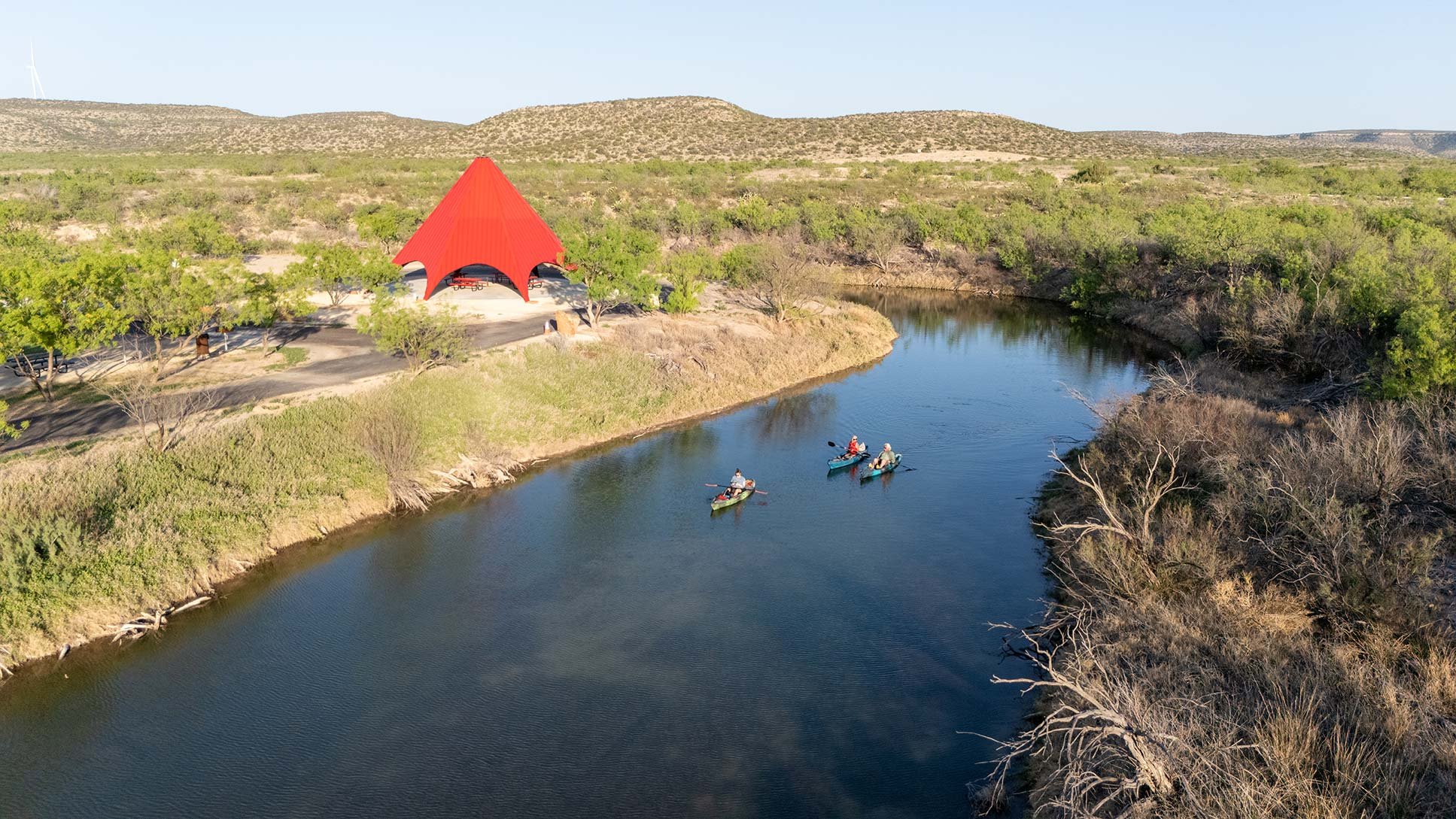
Environmental flows is a “scientific term used to describe the quantity, quality and timing of water that are necessary to sustain the fish and wildlife of a river,” as stated by the Texas Living Waters Project. You’ll also hear the term “instream flows,” which refers to the flows in a river or stream. If you’ve traveled across the Pecos River below Red Bluff Reservoir downstream to Girvin, you have seen firsthand that the Pecos River lacks continuous flow, which disrupts the river ecosystem and water cycle.
In the desert, the Pecos River water cycle is deeply connected to an alluvial aquifer. Water flows through the river and seeps deep into the sandy riverbed where the water is stored. Ideally, in dry times, the alluvial aquifer feeds the river; in wet times the river feeds the aquifer. This system is no longer functioning as it historically has. The alluvial has been lowered and in some places depleted, and the river upstream has been impounded to the point where a natural flow is not occurring.
Texas lawmakers gave a lot of attention to environmental flows in 2007 with the passage of Senate Bill 3. That legislation led to studies, stakeholder groups and a process to establish flow standards specific to river basins. The final report states that the Pecos River reach “from the State Line to Independence Creek has so many alterations and impairments that it needs significant funding for research.” The report also states that strategies to convert some perpetual water rights for flow protection purposes need to be studied. These strategies have never been funded.
The 2012 Environmental Flow report for our basin can be read here: Final Submission to the Environmental Flows Advisory Group, Rio Grande Basin and Bay Area Stakeholders Committee, and Texas Commission on Environmental Quality
A subgroup of stakeholders submitted a supplemental set of important recommendations including new governance, hiring a water master, and engaging the U.S. Army Corps of Engineers. That supplemental memo can be read here: Supplemental recommendations regarding environmental flow standards and strategies to meet these standards.
A Living Waters Project review of Texas’ Environmental Flow protection progress and recommendations for action can be found here: Course Correction: How Texas Can Unlock the Unrealized Potential of Senate Bill 3 For Achieving Meaningful Environmental Flow Protection. By Myron Hess.
More about Environmental Flows from the Texas Commission on Environmental Quality here.
More about Environmental Flows from the Texas Water Development Board here.
More about Environmental Flows from the Texas Living Waters Project here.
The Pecos River Compact
The Pecos River Compact, a legal agreement dating back to 1948 between Texas and New Mexico, specifies how the two states will share the river. The agreement has been back to court several times and continues to cause some tension. Annual accounting for the compact employs the 1947 river condition as a baseline but much has changed since that time. The compact allows for New Mexico to accumulate “credits” that have well-surpassed 100,000 acre-feet. No water is expected to be “delivered” to Texas for the foreseeable future.
The Pecos River Compact Commission was created to oversee the compact agreement. Lourcey Sams, president of the Pecos River Resolution Corp. recently received a federal appointment to serve as chair of this commission, a position vacant for many years. Sams joins a Texas appointee and a New Mexico appointee; they meet in person once a year, typically in April.
Red Bluff Water Power Control District
Red Bluff Reservoir, completed in 1936, is on the Pecos River in Texas, just below the state line in Reeves and Loving counties.
The reservoir is privately owned and operated by the Red Bluff Water Power Control District (RBWPCD), which was created to manage irrigation water supply for seven member districts; Loving County WID #1, Reeves County WID #2, Ward County Irrigation District #3, Ward County Irrigation District #1, Ward County WID #2, Pecos County WID #2 and Pecos County WID #3. Each district elects a representative to serve on the seven-member RBWPCD Board of Directors. The board meets the second Tuesday of each month at the district’s office in Pecos, Texas.
Much has changed in the region since RBWPCD was created by the Texas Legislature in 1933. The Permian Basin region is no longer the agricultural region it was in the early and mid-1900s; it is now one of the largest oil producing regions in the world. Irrigated acres in the Pecos basin peaked at 260,000 acres in 1958; in 2000 that number declined to 73,171 acres, and in 2023 it was estimated to be 57,453 acres.
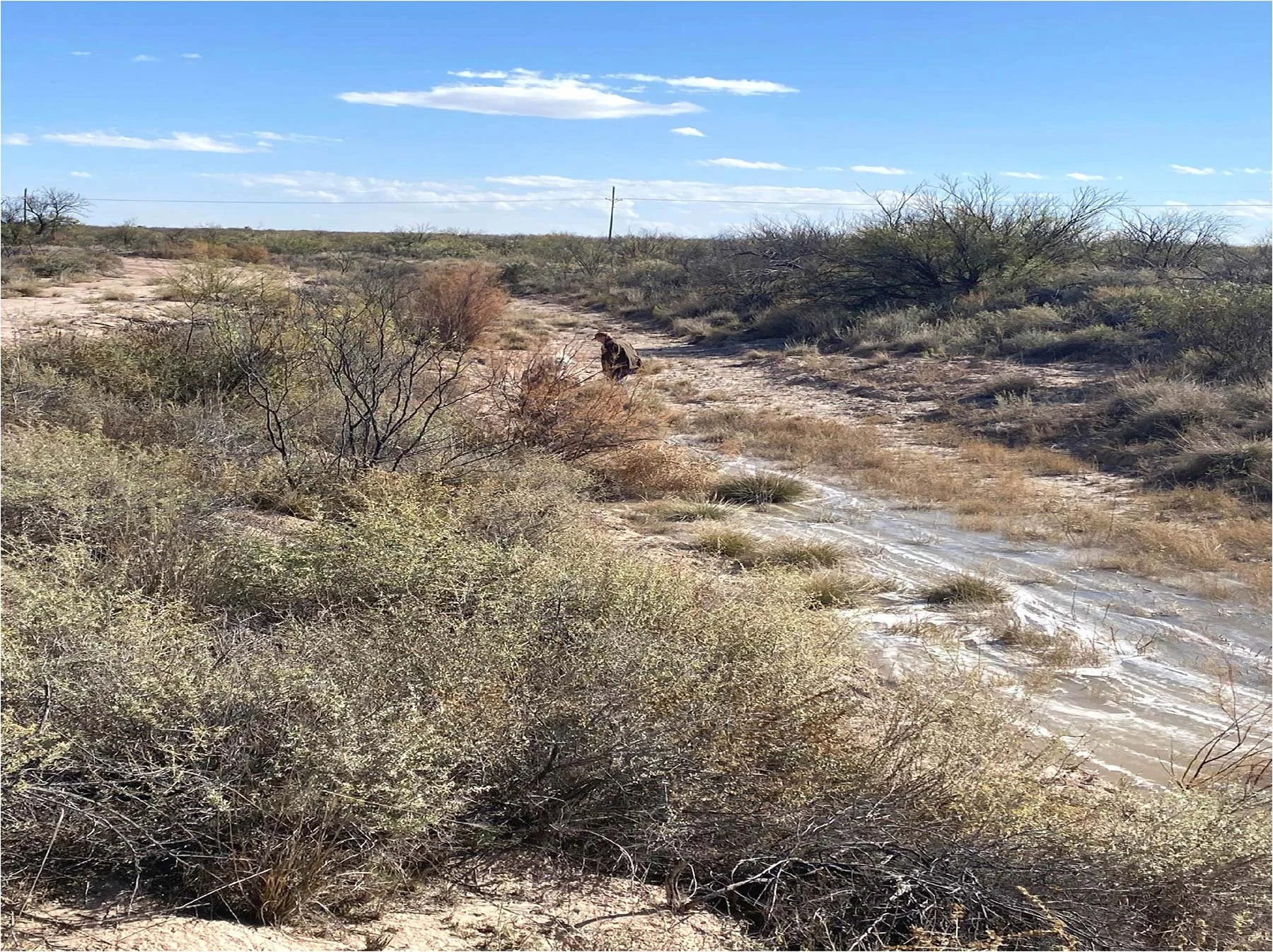
Each year, RBWPCD determines how much water will be available for agriculture deliveries. No deliveries were allotted in 2024 and 2025. The board voted in 2026 to allot 20,000 acre feet of water for the year. Member districts downstream may request water for farmers in their respective districts. Released water travels many miles through dirt canals to reach its destination, and only a small percentage of water arrives after saturation and evaporation occurs. Some water from the reservoir is sold for industry. No water is released purely for the health of the river.
Below Red Bluff Reservoir, the Pecos River is mostly dry and has lost continuity, until groundwater begins to feed the river between Imperial and Iraan.
There is potential to repurpose the RBWPCD and the irrigation infrastructure downstream to support restoration of the water cycle with rangeland restoration and aquifer recharge projects.
Aggregate mining and gravel pits
Aggregate operations and gravel pits have increased along the Pecos River to serve industry and construction in the region. These operations often exist along the alluvial aquifer and can interrupt the water cycle and affect river flow.
Friends of the Pecos River participates in a statewide organization that is seeking to address community and environmental impacts from these operations. Learn more here, Texans for Responsible Aggregate Operations, TRAM
“I love that old Pecos River.
It taught me to swim.”
—Delmon Hodges, who learned to swim in the Reeves County reach in the 1930s, excerpted from Bitter Waters: The Struggles of the Pecos River